Are single-property landlords at greater risk of leaving the sector?
Single-property landlords account for almost half of the private rented sector in England. But NRLA survey evidence suggests this group may be more likely to leave the sector than landlords with larger portfolios. Across 2025, single-property landlords were consistently more likely than those with multiple properties to say they did not expect to remain in the sector by the time the Renters’ Rights Act takes effect. They were also more likely to say they were unlikely to still be landlords by the end of 2026.
When single-property landlords talk about leaving the sector, the issues they highlight tend to differ from those raised by landlords with larger portfolios, particularly around tenancy management and regulatory pressures. The analysis below explores these differences in more detail, and what they might tell us about exit risk across different types of landlords
Signs of higher stated exit risk
Results from the NRLA’s Quarter 4 Landlord Eye consultation suggest single-property landlords are more likely than larger portfolio landlords to say they expect to leave the sector in the near to medium term.
In response to a question about preparation for the Renters’ Rights Act, 9% of single-property landlords said they did not expect to still be landlords when the reforms came into force, compared with 1% of landlords with multiple properties.
In the same quarter, and in a separate question, 38% of single-property landlords said they were either "highly unlikely" or "unlikely" to still be landlords by the end of 2026, compared with 21% of multi-property landlords. Results are shown in chart 1 below.
These figures should be read as indicators of stated intention rather than a forecast of actual exits. Notwithstanding, the data shows a clear difference in sentiment between the two size-based groups of landlords.
Exit discussion rises across the year
Free-text responses from landlords also suggest that leaving the sector has become a more prominent theme over the course of 2025. Across both single-property and multi-property landlords, mentions of selling or exiting rose through the year: they rose to such an extent that, by Quarter 4, the desire to exit accounted for around one in five landlord comments.
But, even in this case, as shown in Chart 2 below, the increase was sharper among single-property landlords. Among this group, exit-related discussion in Quarter 4 was more than double when compared with Quarter 1.
This adds important context to the survey findings. It is not simply that some landlords are selecting an exit-related response in a closed question. More landlords, particularly those with just one property, are also raising and discussing the option unprompted.
Why the concern looks different for single-property landlords
Looking more closely at comments from landlords who explicitly mention plans to sell or leave the sector, further differences emerge. Among both single-property and multi-property landlords, around a third refer to the Renters’ Rights Act or Bill, suggesting policy change forms a common backdrop to exit discussions.
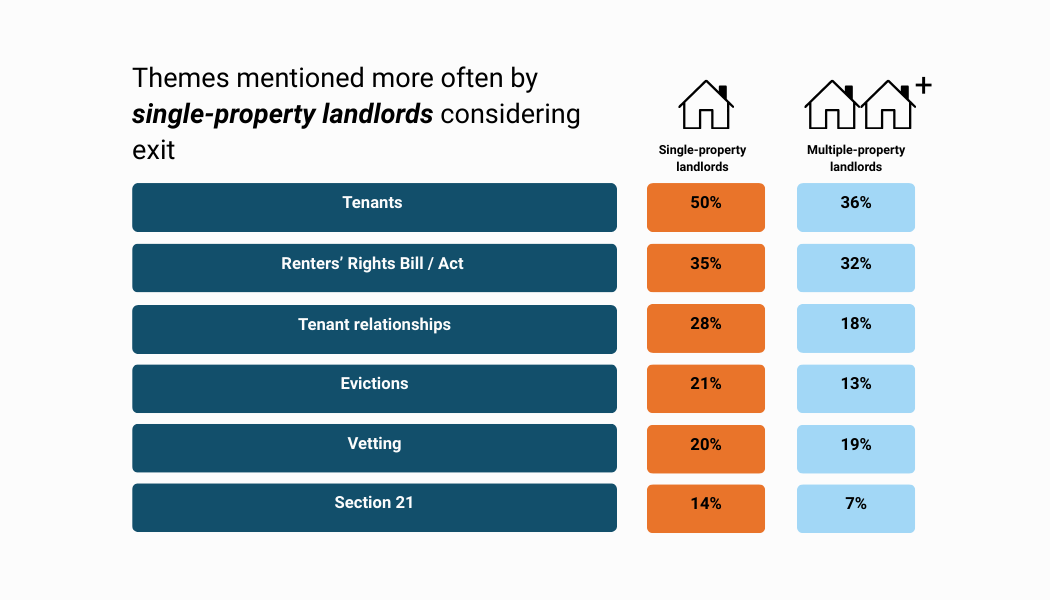
However, single-property landlords discussing exit are more likely to refer to tenant relationships, evictions, Section 21 and the difficulty of regaining possession.
I is a real drawback for an investor not to have control of a no fault eviction. I want to sell up but I shall have to wait for the tenant to vacate the property voluntarily. This could, in theory, be years from now.
New legislation, anti-landlord rhetoric from the government and very high risk factors make the PRS no longer a viable occupation or investment. It is now way too stressfull. I have only one rental property left and I'm hoping the tenants will leave willingly so that I can sell it. It is breaking my heart, as I have never, in 32 years as a landlord, ever evicted any tenants.
Concerns raised by multiple-property landlords
Multi-property landlords - at least those discussing exit - are much less likely to discuss these themes (as Figure 1 above shows). Instead, for this group, broader structural pressures such as tax, EPC requirements and Minimum Energy Efficiency Standards are further up the agenda, shown below in figure 2.
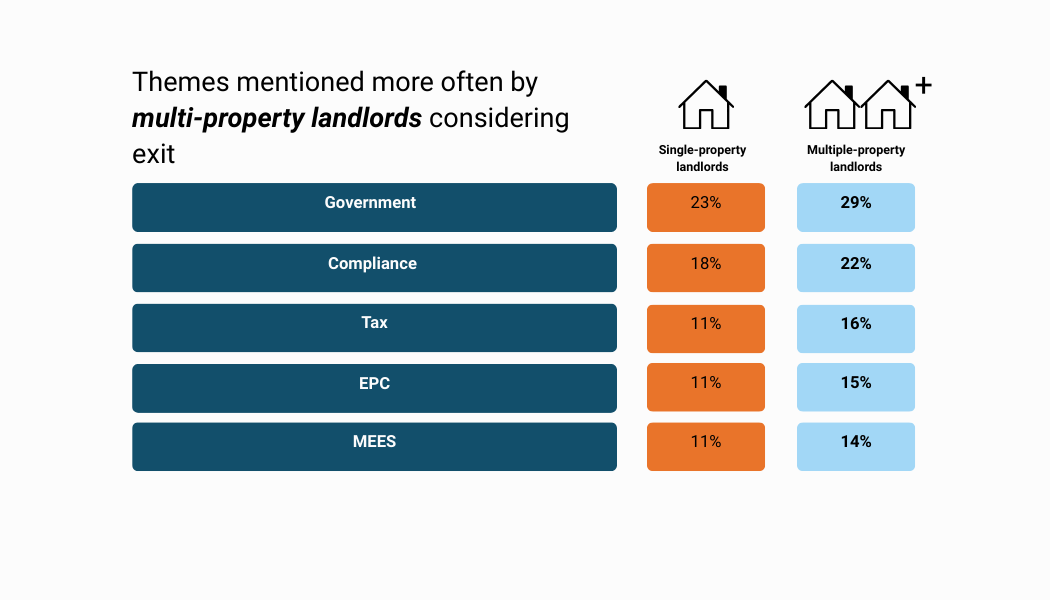
This difference is important. For a landlord with one property, the risks attached to a single tenancy may feel especially acute. The removal of Section 21 may therefore carry particular weight for this group. Where larger landlords may be better able to absorb risk across a portfolio, smaller landlords can be more exposed to the consequences of one difficult tenancy. That appears to be reflected in the language used in their exit-related comments.
A shift in tone by the end of 2025
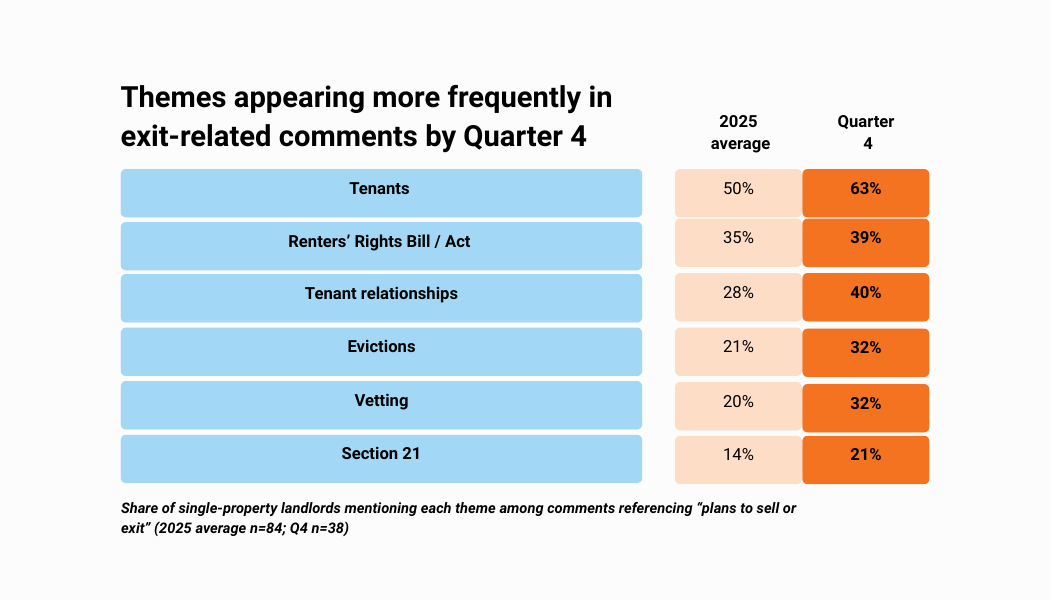
By Quarter 4, exit-related comments from single-property landlords were more focused on tenant risk and the practicalities of managing or ending tenancies than earlier in the year. Though the number of comments among single property landlords is much smaller, it does seem that the completion of the Bill’s passage through Parliament has focused landlords’ minds. Figure 3 illustrates this shift.
Why confidence and exit risk may appear alongside
At first glance, one finding looks contradictory. Across all four quarters of 2025, single-property landlords reported slightly higher confidence levels than those with multiple properties in the NRLA’s Landlord Confidence Index, even though the overall outlook has remained gloomy. This raises an obvious question: why do landlords with higher stated exit intentions also report slightly higher confidence levels?
One possible explanation is that some single-property landlords appear to be thinking in two timeframes at once. In comments referencing selling or leaving the sector, a greater proportion of single-property landlords linked their exit plans to the natural end of a tenancy. Essentially, this describes the case where landlords say they may be postponing a sale to avoid displacing existing tenants.
The implication being, once the current tenant departs, then the property may be sold. This link between landlord exit and the end of a current tenancy appeared in 22% of comments from single-property landlords mentioning plans to sell or exit, compared with 9% among multi-property landlords. This interpretation also aligns with previous NRLA analysis, which shows that landlord confidence is closely associated with positive tenant relationships. Landlords who report stronger relationships with their tenants tend to express higher levels of confidence about their current position in the sector.
What this means for the sector?
Most landlords still expect to remain in the market. But the evidence suggests single-property landlords are more likely than larger landlords to report RRA-linked exit intentions, and that the concerns sitting behind those intentions are often tied to tenancy management and possession risk.
If smaller landlords continue to feel disproportionately exposed to these risks, the sector could gradually become more concentrated in the hands of larger portfolio operators.
It is too early to say whether that will amount to a lasting structural shift. But the pattern is worth watching closely. The key question is no longer just whether landlords are considering leaving, but which landlords are most likely to do so - and why.